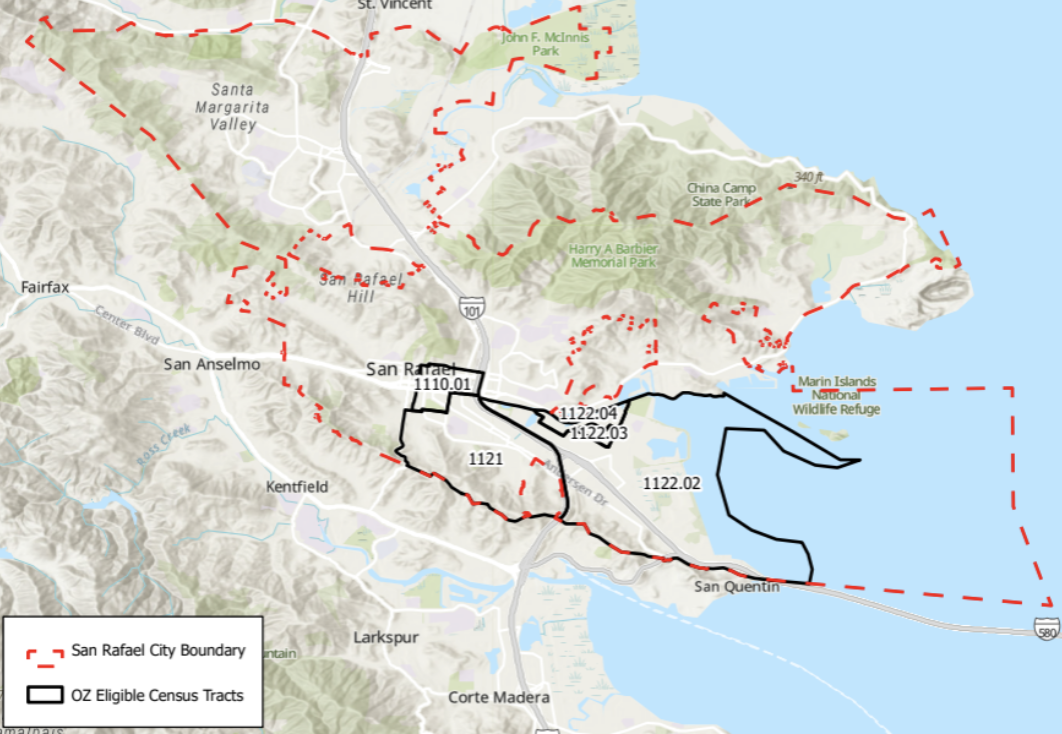
Five Southeast San Rafael census tracts could soon attract tax-advantaged private investment in new construction, business startups, and property rehabilitation, with a public comment period opening Tuesday, August 1, following the City Council's July 20 vote to formally nominate them for the federal Opportunity Zone 2.0 program.
The resolution sends San Rafael's picks to the California Governor's Office of Business and Economic Development, known as GO-Biz. The Governor has until September 30 to forward nominations to the U.S. Treasury, which will certify a new national OZ map effective January 1, 2027, for 10 years.
As we reported July 17, the vote was one of several major items on the council's July 20 agenda.
What's nominated
The city nominated all five of its eligible tracts, ranked by priority in the staff report prepared by Economic Development Manager Stacey Laumann and Housing Program Manager Alexis Captanian:
- Tract 1122.02: Southeast San Rafael/Canalways area, including an 85-acre salt marsh between the Target shopping center and Spinnaker Point
- Tract 1110.01: Downtown San Rafael near the Transit Center, where close to 500 new housing units are already entitled
- Tract 1122.04: Waterfront Canal
- Tract 1122.03: Central Canal
- Tract 1121: Francisco Boulevard West/Woodland
The San Rafael Chamber of Commerce's East San Rafael Working Group advocated for all three Canal/Southeast tracts, with 1122.02 as its top choice, according to the staff report.
What OZ 2.0 means for investors and residents
The Opportunity Zone program, created under the 2017 Tax Cuts and Jobs Act, gives investors preferential federal tax treatment on capital gains they put into qualifying projects in low-income census tracts. Eligible investments include new real estate construction, rehabilitation of vacant or underutilized properties, equity in operating businesses, and infrastructure or energy projects, according to the city's announcement.
Congress made the program permanent through the "One Big Beautiful Bill Act" of 2025. It had been set to expire December 31, 2026.
Displacement concerns
The Canal district, where three of the five tracts sit, covers about 2.2 square miles and is home to more than 13,000 low-income residents, predominantly Hispanic, living in crowded multifamily housing, NorCal Public Media reported in early July.
San Rafael has history with the program's downsides. In 2018, one Canal tract was designated an OZ without city input. Speculative investors purchased buildings, raised rents, and evicted tenants to renovate. The city responded with Ordinance 1992 in 2021, increasing relocation assistance for no-fault evictions in those tracts.
Two of the five nominated tracts, 1122.03 and 1122.04, already carry OZ 1.0 designations expiring December 31, 2026. If they are not re-designated under OZ 2.0, the relocation protections tied to that ordinance also expire.
The stakes are real.
"There are certain projects that I think could show up in our communities, things that we don't want," Councilmember Eli Hill said at the council's Economic Development and Housing Subcommittee meeting June 16, as reported by NorCal Public Media. "Certain types of investments that could end up, without the right guardrails, could be opportunities for displacement and extractive activities."
City staff acknowledged the risk and said they will return to the council in late summer or early fall for anti-displacement policy updates.
What happens next
The Governor can nominate up to 618 of California's 2,469 eligible tracts by September 30. The Southeast San Rafael Specific Plan, now underway, will hold its first community event in fall 2026.